
You've worn glasses or contact lenses long enough. The idea of waking up and simply seeing - without reaching for anything - sounds almost too good to be true.
It isn't. But there's a decision to make first.
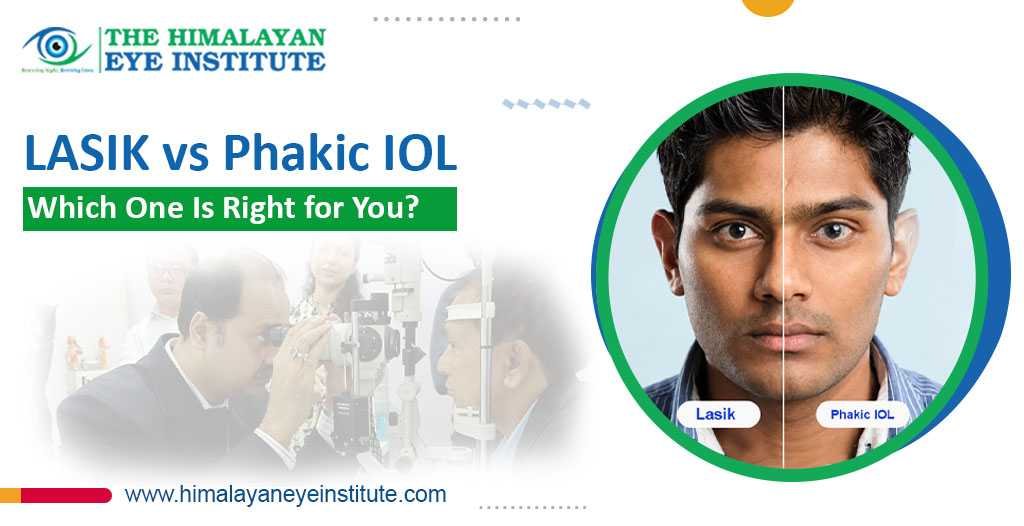
LASIK and Phakic IOL are both excellent ways to correct your vision permanently. Both are safe, well-established, and performed by experienced eye surgeons. The problem is that they're not interchangeable. What works brilliantly for one person can be completely wrong for another - and choosing the right procedure is the difference between a remarkable outcome and a disappointing one.
This guide cuts through the confusion. No jargon, no sales pitch - just a clear explanation of what each procedure does, who it's right for, and how the best eye doctors in Siliguri determine which one is appropriate for your eyes.
The Short Answer First
LASIK reshapes your cornea using a laser. The cornea needs to be thick enough to reshape safely, and your prescription needs to be within a certain range. If your cornea qualifies, LASIK is fast, effective, and requires no implant.
Phakic IOL (ICL) places a thin, soft lens inside your eye - in front of your natural lens. The cornea is not touched. It's the preferred solution for people with high prescriptions, thin corneas, or eyes that simply aren't suitable for LASIK.
The question isn't which is better. It's what is right for your specific eyes. And only a proper screening - not a quick consultation - can answer that.
LASIK vs Phakic IOL at a Glance
|
|
LASIK |
Phakic IOL (ICL) |
|
How it works |
Laser reshapes the cornea |
Soft lens implanted inside the eye |
|
Procedure time |
Around 5-10 minutes |
Around 10 minutes |
|
Is Cornea involved? |
Yes - tissue is removed |
No - cornea is untouched |
|
Best for |
Mild to moderate prescriptions |
High prescriptions, thin corneas |
|
Prescription range |
Up to approximately -10.00 D |
Up to -30.00 D and beyond |
|
Recovery time |
Next Day |
Next Day |
|
Reversible? |
No |
Yes - lens can be removed |
|
Natural lens kept? |
Yes |
Yes |
|
Minimum age |
18+ with stable prescription |
18+ with stable prescription |
What Is LASIK and How Does It Work?
LASIK - Laser-Assisted In Situ Keratomileusis - has been performed for decades and has one of the most robust safety records in elective surgery.
The procedure works by creating a thin flap in the outer layer of the cornea, folding it back, and using a precise excimer laser to reshape the tissue underneath. The flap is then replaced - it seals naturally without stitches. The whole thing takes around 30 minutes, you go home the same day, and most people notice significantly improved vision by the following morning.
What LASIK corrects: short-sightedness (myopia), long-sightedness (hyperopia), and astigmatism - within certain ranges.
What LASIK requires: a cornea that is thick enough to safely reshape. This is the critical factor. Remove too much tissue and the structural integrity of the eye is compromised. If your cornea is too thin - or your prescription too high - LASIK is not the right choice for you. Using it anyway would be dangerous.
Potential side effects to know: dry eyes are the most common, particularly in the first few months. Some people experience glare or halos around lights at night. Most resolve with time. These are uncommon when candidacy has been properly assessed.
What Is Phakic IOL (ICL) and How Does It Work?
Phakic IOL - also called ICL (Implantable Collamer Lens) - takes a completely different approach. Instead of changing the cornea, a thin, soft lens is placed inside the eye, sitting just in front of your natural lens.
Your natural lens stays exactly where it is. Your cornea is untouched. The implanted lens works with your eye's own optics to give you clear, spectacle-free vision.
The procedure takes around 10 minutes and is painless. The lens - made from a biocompatible material - is rolled up, inserted through a tiny incision, and unfolds into position inside the eye.
One thing that surprises most people: Phakic IOL surgery is a very safe procedure with a high success rate. And unlike LASIK, it's reversible - if needed, the lens can be removed. This makes it particularly appealing to people who want the option of future flexibility, or who may eventually need cataract surgery when the natural lens is replaced.
What Phakic IOL corrects: high myopia - prescriptions that are too strong for LASIK to handle safely. It's effective for prescriptions well beyond what laser treatment can manage.
Who benefits most: people with high prescriptions (typically above -8.00 D), thin corneas that wouldn't survive LASIK, or large pupils that might cause issues with laser surgery.
The Most Important Difference - and Why It Changes Everything
Here's the thing people often miss when comparing LASIK vs Phakic IOL: the choice isn't primarily about preference. It's about what your eyes can safely tolerate.
Corneal thickness is the deciding factor in most cases. LASIK removes corneal tissue. If there isn't enough to safely remove, LASIK cannot be done - regardless of how much you want it.
Prescription level matters too. High myopia or high minus power is becoming a rapidly increasing medical and social problem. Permanent power correction is possible today by using laser (LASIK/PRK) or implantable collamer lens (ICL/Phakic IOL). Very high prescriptions - above approximately -10.00 D - typically fall outside the safe range for laser treatment. Phakic IOL handles these cases where LASIK cannot.
Some people need both - at different points in their life. A 44-year-old patient had a history of two refractive surgeries performed in both eyes - LASIK around 20 years ago, followed by ICL/Phakic IOL implantation in both eyes 10 years ago. As eyes change over decades, treatment needs can evolve. This is why working with experienced eye surgeons who take the long view matters.
How Do Eye Doctors Determine Which Procedure Is Right for You?
This is where the science happens - and where the quality of the diagnostic equipment directly affects the accuracy of the recommendation.
LASIK may not be appropriate for everyone. A Pentacam screening test can help determine whether you should go for LASIK or Phakic IOL. The Himalayan Eye Institute brings the OCULUS Pentacam - the Gold Standard in anterior eye segment tomography.
The Pentacam maps the shape, curvature, and thickness of the entire cornea in three dimensions. It identifies corneas that look normal but have subtle irregularities that would make LASIK unsafe - conditions like early keratoconus that could worsen dramatically if laser treatment were applied.
Beyond Pentacam, a complete refractive surgery evaluation at our eye hospital in Siliguri includes:
- Specular Microscopy - counts and assesses the health of the endothelial cells lining the inside of the cornea. These cells are critical for corneal clarity, don't regenerate, and must be in good health before any intraocular procedure like Phakic IOL.
- Optical Biometry - measures the dimensions of the eye to determine the correct size of the Phakic IOL to be implanted.
- 3D OCT - provides detailed imaging of the anterior segment structures, including the angle of the eye where the IOL will sit.
- HFA Perimetry - maps the visual field, ensuring no underlying conditions are present that might affect the outcome.
- Refraction under cycloplegia - gives the most accurate measurement of the prescription with the eye's focusing muscles fully relaxed.
This level of evaluation takes time. It requires equipment that most optical shops and basic clinics don't have. But it's what separates a recommendation you can trust from a guess.
Who Is a Good Candidate for LASIK?
You're likely a good candidate for LASIK if:
- Your prescription is within the treatable range (roughly up to -10.00 D for myopia, depending on corneal thickness)
- Your corneas are thick enough to safely reshape
- Your prescription has been stable for at least 6–12 months
- You're 18 or older
- You don't have dry eye disease, keratoconus, or other corneal conditions
- You're not pregnant or breastfeeding
LASIK is not suitable if your corneas are thin, your prescription is very high, or your Pentacam reveals any corneal irregularity - even subtle ones.
Who Is a Good Candidate for Phakic IOL?
Phakic IOL tends to be the right choice when:
- Your prescription is high - typically above -8.00 D to -10.00 D
- Your corneas are too thin for safe LASIK
- You have a large pupil size that may cause optical issues with laser surgery
- Your Pentacam reveals corneal irregularities that rule out LASIK
- You want a reversible option
- You are over 18 years of age and your power has been stable in the last 6 months, with no other eye disease such as cataract, glaucoma, or retinal or optic nerve pathology present
One thing worth knowing: anyone with minus power who wishes to get rid of spectacles can undergo eligibility screening at our hospital - a number of tests are done to determine the suitability of your eye for this procedure.
What Happens When LASIK Isn't Enough - and ICL Comes Later
Here's a scenario that plays out more than people realise.
Someone has LASIK in their twenties. Their prescription was borderline high but within the treatable range. The surgery works well. Years pass. The residual prescription that couldn't be corrected by LASIK, combined with the natural changes in the eye over time, means glasses are needed again for certain tasks.
At this point, further laser treatment may not be possible - there's no remaining corneal tissue to safely reshape. This is where Phakic IOL becomes the second-stage solution, correcting what laser treatment could not or did not fully address.
This is not a failure of either procedure. It's the nature of an eye that changes over decades. Understanding this trajectory is part of what an experienced refractive surgeon considers when making the initial recommendation.
Frequently Asked Questions About LASIK vs Phakic IOL
Q1. What is the main difference between LASIK and Phakic IOL?
LASIK reshapes the cornea using a laser - removing tissue to change how light bends into the eye. Phakic IOL implants a soft lens inside the eye without touching the cornea. LASIK suits mild to moderate prescriptions with adequate corneal thickness. Phakic IOL suits high prescriptions or eyes where LASIK is not safe. The choice is determined by your eye's anatomy, not personal preference.
Q2. Can everyone with glasses get LASIK?
No. LASIK requires adequate corneal thickness, a prescription within treatable ranges, and a cornea that's structurally regular. A Pentacam evaluation - the gold standard screening test - determines candidacy accurately. Many people who believe they're LASIK candidates discover through proper screening that Phakic IOL is the safer and more effective option for their eyes.
Q3. Is Phakic IOL safe?
Yes - it has an excellent safety record with high success rates. The procedure takes around 10 minutes, is painless, and the lens can be removed if ever needed. Endothelial cell count must be adequate before the procedure, which is why specular microscopy is part of the pre-operative evaluation.
Q4. Can I have LASIK if I have a high prescription?
It depends on your corneal thickness more than the number itself. Some corneas can safely accommodate higher corrections; others cannot. A Pentacam evaluation gives a definitive answer. Generally, prescriptions above -10.00 D are more reliably and safely treated with Phakic IOL - but this varies by individual.
Q5. Is Phakic IOL reversible?
Yes. The lens can be removed if needed. This is one of its significant advantages over LASIK, which permanently alters the corneal tissue. When a patient who has had Phakic IOL eventually develops a cataract, the ICL is removed and replaced with an artificial lens during cataract surgery - a well-understood and routine process.
Q6. Where can I get LASIK or Phakic IOL evaluation in Siliguri?
The Himalayan Eye Institute in Siliguri offers comprehensive refractive surgery evaluation using the OCULUS Pentacam, Specular Microscopy, Optical Biometry, 3D OCT, and Perimetry - the full range of diagnostic tools needed to make an accurate, safe recommendation. Our refractive surgery team evaluates each patient individually and recommends the right procedure based on clinical findings - not on what's more convenient to offer.
Refractive Surgery in Siliguri - The Himalayan Eye Institute
Choosing between LASIK and Phakic IOL is not a decision to make based on a quick consultation, a price comparison, or what worked for a friend. It's a clinical decision - one that requires the right diagnostic tools and the experience to interpret what they reveal.
The Himalayan Eye Institute brings the OCULUS Pentacam - the Gold Standard in anterior eye segment tomography. Besides Pentacam, the advanced ophthalmic diagnostics at the hospital include Optical biometry, 3D OCT, HFA perimetry, and Specular Microscopy.
Our refractive surgery team has experience with both LASIK and Phakic IOL - which means the recommendation you receive is genuinely based on what's right for your eyes, not on what's available or easier to perform.
The Himalayan Eye Institute serves as a preferred eye care destination for patients from North Bengal, neighbouring Indian states, and nearby countries such as Bhutan, Bangladesh, and Nepal. Patients travel for refractive surgery evaluation because they want the answer they can trust - not the answer they want to hear.
NABH Certified | 4.9? on Google | 9,000+ Patient ReviewsNorth Bengal's Largest Private Eye Care Centre | Established 2016
Hospital TimingsMon – Sat: 8:30 AM – 7:00 PM | Sunday: 9:30 AM – 12:30 PM Evening OPD (Mon–Sat): 5:00 PM - 7:30 PM
Book Your Refractive Surgery Evaluation
+91 89007 99992 / +91 74077 40723
0353-250 2500 / 0353 250 2501
info@himalayaneyeinstitute.com
appointment.himalayaneyeinstitute.com
Jhankar More, Burdwan Road, Siliguri – 734005